Your agent doesn't need RAG to read PDFs
Hand an agent a 1,151-page book and most assistants either load the whole thing into context or bolt a RAG pipeline onto it. Ogcode takes a third path: label every page once, keep the labels in a table you can read, open only the pages a question actually needs, and answer with a page number you can check.


Picture a research librarian holding a 1,151-page book. You ask: where does this book explain the Transformer architecture? A good librarian does not photocopy the whole book for you. They remember what each page is about, because they filed it, one page at a time, and they wrote a short label on the tab of each folder. Page 14: the chapter contents for attention and transformers. They hand you exactly one page. The other 1,150 stay in the cabinet.
Now picture an AI agent handed the same book. What most assistants do is either photocopy the cabinet or build a machine next to it that guesses which pages you might want.
This post is about the third path we wired into Ogcode: label every page once, keep the labels in an ordinary table, and let the agent open exactly the pages a question needs. It is cheap per question, it is small enough to hold in your head, and it is the only one of the three that can tell you which page it read.
First, how does an agent usually meet a PDF?
An agent only sees text. For PDFs, most assistants have two moves, and neither scales:
- Extract everything and print it. The whole file becomes one giant blob in the conversation. A real technical book turns into hundreds of thousands of tokens on turn one, and those tokens stay in the context window for the rest of the session. On a big enough PDF the blob does not even fit, and the part that gets cut is whatever the extractor hit first. The agent has no idea what fell off, and on a book, most of the book fell off.
- Bolt on RAG. Chunk the pages into overlapping fragments, embed every fragment into a vector store, and at question time retrieve the top few by cosine similarity. It works, and it is the standard answer, but notice what it costs you. You now run and maintain a second system. The embeddings are opaque: nothing you can print, read, or audit. The model answers from fragments, not pages: excerpts with no neighbors, no page numbers, and no guarantee you got the page where the sentence you half remember actually lives.
Both moves pay a tax on every question, in tokens or in infrastructure, before anyone has read a single page.
Ogcode’s answer: label every page once, then open only what a question needs
There are two parts, and like the spreadsheet fix, they share one brain: a one-time labeling pass over the file, and a pair of tools that make the labels cheap to act on.
Part one: the labeling pass
Ogcode scans every page of every PDF in your workspace with a plain-text extractor, collects the keywords that actually occur on each page, and hands those keyword lists to the model in small batches. The model returns page labels: short phrases that say what each page is about. Nothing fancy is stored. Each page lands as one ordinary row in an ordinary SQLite table, keyed by file and page number:
doc_path                              page_num  labels
demo-pdfs/d2l-en-book.pdf             14        Transformer Architecture, Positional Encoding, Vision Transformers, ...
The whole labeling job for our 1,151-page test file ran as twelve background sessions (pages go in batches of up to 100, and the keyword format keeps each batch’s prompt under 50 KB). No embeddings, no vector store, no retrieval infrastructure. If you want to audit what the agent knows about your documents, you can print the whole table. It is a card catalog you can read.
Labels are made by the model, so they are a summary with judgment in them, not a mechanical keyword dump. That judgment is what makes labels like “Training Transformers” or “Positional Encoding Details” show up on the right pages.
The pass is frugal about when it runs. Each file carries its last-modified
time in the index, so nothing is rescanned unless the file actually changed.
You can rebuild with ogcode index at any time, and the agent triggers the
same refresh after a completed work turn. The labeler also runs politely: it
shares your provider’s connection and yields to your actual requests first.
Indexing your PDFs is a background errand, not a job that competes with the
work you are paying for.
Part two: the map and the page
Labels are only useful if the agent finds them at the right moment. When the agent surveys your project (the codebase map it checks before opening files), each PDF shows up as a single entry with its page labels folded together, capped at thirty. The agent sees “this is the Dive into Deep Learning book, and it covers CNNs, RNNs, attention, optimization, GANs” before it has opened anything.
Then two tools do the page-level work:
- pdf_index lists the labels page by page. It never opens the file. It reads only the table, which is why it costs almost nothing.
- read_pdf_page opens exactly one page and returns its plain text. If that page has almost no extractable words (a full-page figure) and the model can see, it renders that page to an image at a bounded resolution instead, and falls back to text if the image cannot be produced. Either way, the unit of reading is the page, with a page number you chose from the index.
The pairing is deliberate, and there is a test that keeps it that way: an agent that jumps straight to reading a PDF page with a page number it had no way of knowing is failing, and the tool layer refuses to paper over it. The index and the page have to travel together.
A real book, three steps
Our test file: Dive into Deep Learning, the full printed book as a single PDF. 1,151 pages, 44.7 MB, 2.1 million characters of extracted text. Real typeset text, equations, figures, code listings, and a forty-page detailed table of contents up front. Here is the actual session, against the real index Ogcode built from it.
Step one: pdf_index gives the page-level map. Straight from the
table, no file opened (labels trimmed for fit):
{"page": 13, "labels": ["Attention Mechanisms and Transformers",
  "Queries Keys and Values", "Scaled Dot-Product Attention",
  "Multi-Head Attention", "Self-Attention", "Positional Encoding"]},
{"page": 14, "labels": ["Positional Encoding Details",
  "Transformer Architecture", "Transformer Encoder",
  "Transformer Decoder", "Training Transformers",
  "Vision Transformers (ViT)"]}
Step two: ask the question against the labels. “Where does the book walk through the Transformer architecture, and how does it train one?” The labels answer it before any page is read: page 14 carries the whole Transformer cluster: model, encoder, decoder, training. The card catalog alone did the finding.
Step three: one page gets read. read_pdf_page, page 14:
11.6.3PositionalEncoding
437
11.7TheTransformerArchitecture
440
11.7.1Model
441
11.7.2PositionwiseFeed-ForwardNetworks
442
11.7.3ResidualConnectionandLayerNormalization
443
11.7.4Encoder
444
11.7.5Decoder
445
11.7.6Training
447
11.8TransformersforVision
451
That is the honest raw output: the exact section numbers and page numbers, 440 to 451, where the book defines, implements, and trains the transformer. You can also see the extractor’s one imperfection on dense pages: inside-line spacing sometimes collapses, so “PositionwiseFeed-ForwardNetworks” reads as one word. For an agent that wanted to know where, it is plenty: it now reads page 450 next, because that is where the training loop lives. What matters is the shape of the trade: one page of tokens, on demand, instead of 1,151 pages of PDF parked in everyone’s context for the whole session.
The same book, three harnesses
Numbers, because “fewer tokens” is easy to claim and easier to fudge. Same book, the three ways a harness can meet a PDF. Token counts here are character counts divided by four, the standard back of the envelope: treat each figure as an estimate, and trust the shape.
A single question on a small file flatters every harness. Nobody actually works that way. Real use is a pile of questions against the same file: what does this section say, where is the derivation, which page defines the metric. Multi-question sessions are where the three strategies stop pretending to be equivalent, and where one of them is simply the best.
| Dimension | Dump the file | RAG pipeline | Ogcode: labels, then pages |
|---|---|---|---|
| Setup | nothing to build | chunk the text into ~500-token windows, embed all ~1,040 fragments into a vector store, tune top-k | one background labeling job: the model reads ~400k tokens of page keywords across twelve sessions and returns ~100k tokens of labels |
| What the model sees per question | all 1,151 pages, ~532,000 tokens, more than most context windows will accept | the top ~5 fragments (~1,500 tokens), picked by cosine similarity | the label table (the full catalog is ~100,000 tokens; the folded map view is a few hundred) plus one page, ~460 tokens |
| A ten-question session | ~5,300,000 PDF tokens carried through the window | ~15,000 fragment tokens, plus ten embedding round trips | ~13,000 page tokens, measured in the gauntlet below; some answers cost only the labels |
| Where the answer lives | whole pages, all of them, all at once | fragments with no neighbors and no page numbers | whole pages you can cite by number |
| How you check the answer | re-read the blob and hope it survived intact | the similarity scores, if you kept them | turn to the page number in the answer |
| How it fails quietly | the blob gets cut, and the model answers from whatever survived the cut | the retriever misses the chunk, and nothing tells you | a wrong label costs exactly one page read to correct |
| Where the cost goes as questions pile up | nowhere good: the blob rides every turn | flat per question, but rebuilt from zero every time | down: after the first two questions the agent knows the map and opens only pages |
One footnote, kept honest: on a first question, RAG and Ogcode spend about the same number of tokens. Five chunks and a page or two are the same order of size, and we will not pretend otherwise. From the second question on, the two part ways. RAG rebuilds its answer from zero every time: rank the chunks, re-embed, hand over fragments that carry no memory of the question before. Ogcode’s agent has already read the label map, so a later question usually costs one page read, and some cost nothing but the labels. The labeling job itself costs more than any single question would (~400k tokens of keyword input, ~100k of labels out), but on a different clock: the blob enters your working session and rides along every turn, while the labeling job happens once in the background, split across twelve sessions, and never enters the working conversation at all. Amortized over every question this file will ever get asked, it is the cheapest line in the table.

Speed is not close either. The catalog lives in SQLite, so pdf_index never opens the 44.7 MB file: a label lookup is a database read, effectively instant, and read_pdf_page decodes a single page. No embedding round trip, no retrieval service to wake up, and the first question costs the same as the tenth. Against the dump, the win is bigger than tokens: a smaller context is a faster model. Five hundred thousand tokens of book slow down every answer in the session, on the models that can hold it at all, whether or not the question touches the book.

The shape of the result is the point. When the file fits in your window, the argument is “fewer tokens”; at 1,151 pages it is “fewer tokens versus a file your context cannot hold”. The dump’s cost curve ends in a wall. Retrieval’s cost curve stays flat but maps the book with fragments, cold every time. This one stays flat too, it maps the book with citable pages, and it is the only one that gets cheaper as the questions add up.
Ten questions, asked, answered, and measured
Estimates are cheap, and the Ogcode row in the table above is still arithmetic on a page count. So we ran it for real: ten straight questions, eight on the deep learning book and two on Mathematics for Machine Learning, answered through the actual flow. Labels first, then only the pages the labels point at, with every page recorded. Tokens are extracted characters divided by four, the same convention as before, and page numbers are the PDF’s own numbering.
| Question asked | Pages opened | Page tokens |
|---|---|---|
| d2l · Derive the attention pooling estimator (Nadaraya-Watson) and say where it lives. → A weighted average over kernel similarities (boxcar, Gaussian, Epanechnikov); the from-scratch code normalizes kernel weights and averages training labels. | 455–457 | ≈1,600 |
| d2l · Why does Xavier initialization pick the variance it does? → Forward and backward stability cannot both hold exactly; the book splits the difference at σ² = 2/(n_in + n_out). | 227–228 | ≈1,325 |
| d2l · What separates overfitting from underfitting, and how do you diagnose it? → The training-vs-validation gap, read against model complexity; overfitting “is not always a bad thing”. | 154–155 | ≈1,550 |
| d2l · Show the GRU implemented from scratch. → Three gate weight triples, blending H = Z⊙H + (1−Z)⊙H̃, then the concise nn.GRU version. | 419–420 | ≈900 |
| d2l · Why do residual connections help deep networks train? → Nested function classes: learning the identity is trivial, so a deeper model never has to do worse. | 342–344 | ≈1,750 |
| d2l · Which image augmentations does the book demonstrate, and where? → Horizontal and vertical flip, resized crop (10–100% of area, ratio 0.5–2), color jitter, on CIFAR-10. | 633–634 | ≈900 |
| d2l · Softmax regression and cross-entropy: what is the key gradient? → ∂l/∂oⱼ = softmax(o)ⱼ − yⱼ, the same shape as linear regression. | 169–170 | ≈1,425 |
| d2l · What does the book argue for moment-based optimizers over plain SGD? → A leaky average replaces the instantaneous gradient; Adam adds a second moment; Yogi when variance is high. | 550, 573, 576 | ≈1,550 |
| mml · Where is the SVD defined, and what is it used for? → Theorem 4.22, A = UΣVᵀ, which “applies to all matrices”; used for low-rank approximation, compression, topic modeling. | 125, 135 | ≈1,050 |
| mml · Where is the Gaussian defined, and what does the section emphasize? → Univariate and multivariate densities; marginals and conditionals of Gaussians are Gaussians. | 203–204 | ≈995 |
| All ten questions | 23 page opens | ≈13,000 |
That is the whole context bill for ten substantive questions about two books: about 13,000 tokens of PDF text, against 532,000 per question for the dump and about 1,500 plus an embedding call per question for the RAG pipeline. It also lands a rounding error away from the ~12,000 the table estimated, which is the point of measuring: the estimate was arithmetic, and the arithmetic held.
One wrinkle worth keeping in view: pdf_index reports a file’s whole catalog in one response, and on book-sized indexes that response trims itself to fit its output budget. Both runs hit the trim, on 1,151 pages and again on 417. On the smaller book, one question’s labels sat past the trim, and the agent still landed on the exact section by calibrating printed page numbers against a page it had opened. Nothing was lost, because the catalog is an ordinary table the agent can read any slice of, but a paging parameter would let the tool tell the whole story on its own. It is on the list below.

Accuracy: the page is the citation
Tokens are easy to count and accuracy is easy to gesture at, so here is what the ten questions showed.
Twenty-three pages were opened and not one of them was a miss. Every answer in the table above came back attached to a page you can turn to, and most carried the book’s own words or formulas. Question two is a fair sample. Asked why Xavier initialization chooses the variance it does, the agent read the labels, opened pages 227 and 228, and came back with the real argument: keeping activation variance stable in the forward pass wants n_in·σ² = 1, keeping gradient variance stable in the backward pass wants n_out·σ² = 1, and both cannot hold at once, so the book splits the difference at σ² = 2/(n_in + n_out). Then the book’s own closing line: “This is the reasoning underlying the now-standard and practically beneficial Xavier initialization.” Two pages, no retrieval infrastructure, and a citation you can check by turning to the page.
That is not luck from a good run. Three properties of the design put it there.
The unit you retrieve is the unit you cite. A page carries a number, and the number survives all the way into the answer. A 500-token window carries whatever the chunker decided to cut, so if you want a page number back you have to store one alongside every fragment and hope the sentence you need did not land across the boundary.
Answers need their neighbors. The Xavier explanation is two paragraphs of argument: what the forward pass wants, what the backward pass wants, and why neither can have its way. A retriever that returns the second paragraph alone hands the model a conclusion with the premise missing, and the model will still write something confident. A page keeps the passage whole, and the next page is one call away, so reading on is a decision the agent makes instead of a fragment boundary deciding for it.
A miss is visible. When a label is wrong, the page it pointed at does not contain the answer. You see that for the price of one page read, and the right page is one call further on. The dump fails by cutting text you cannot tell was cut; a retriever fails by returning a fragment that looks like an answer. This one fails by handing you a page that is not about the question, which is the rare failure mode that announces itself.
Some questions do not turn on degree at all. Three of the ten asked where something lives, and for those the label table narrowed a whole book to a page or two before anything was read: the SVD on pages 125 and 135, the Gaussian on 203 and 204. A dump flattens the book into a stream, and a fragment is a slice of that stream; neither keeps a page boundary it was not built to keep. The index is a page boundary, so “which page” is a question it can answer at all.
What this does not prove. We did not run a graded head-to-head against a tuned RAG pipeline, and a number from a hurried one would be a rigged comparison, not a measurement. Embedding retrieval is good at finding passages, and on many questions it will put the right material in front of the model. The claim here is narrower and measured: on this book, with this index, every answer came back attached to a page, and every page opened was on topic.
What you actually run
Whatever you build, you also have to keep alive. Here is the whole of each approach, side by side:
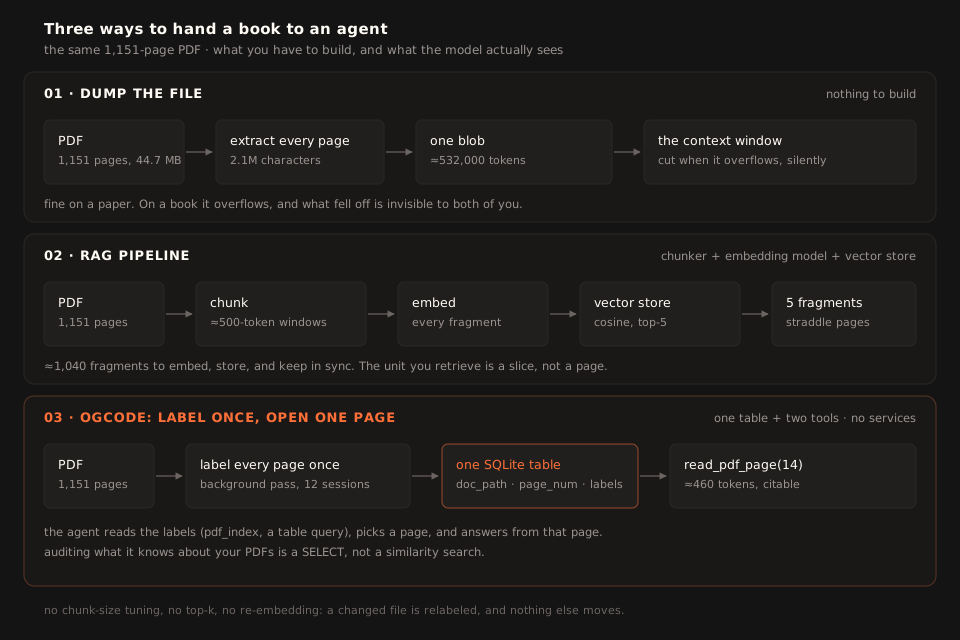
The dump needs nothing, which is its one virtue. RAG needs a chunker, an embedding model, a vector store, and a retrieval step, plus the tuning that makes them agree with each other and the second copy of every document that lives in the store instead of on your disk.
Ogcode’s PDF path needs a labeler, a table, and a reader. The table is the project’s own SQLite database, one row per page: the file path, the page number, the page’s keywords, its labels, and when it was indexed. That is the whole data model. There is no chunker to tune, no embedding model to choose, no vector store to run, no top-k to guess, and no reranker.
Three properties fall out of that, and they are the difference between simple and merely small:
- The index outlives the model. Labels are text, so they read the same to whichever model you route the next question to. An embedding index is bound to the model that built it: switch embedding models and the whole corpus goes back through the mill before the next search is trustworthy.
- Auditing is a query. You can print what the agent believes about every page of a document, diff an index before and after a rebuild, or grep it. A nearest-neighbour neighbourhood is not a thing you can read.
- The failure is local. A wrong answer traces to a row and a page: the label was thin, or the page did not say what its label promised, and either way the next step is one more read. The same miss inside a retriever is a number you argue with.
None of this makes the index free: the labeling pass costs about 400k tokens of keyword input and 100k tokens of labels for this book, in the background, once. What it buys is that the expensive, unfamiliar machinery never exists, and what remains is a table you could have written yourself.
Which one, then
For a single throwaway question on a file small enough to paste, paste the dump. It is fine, and there is nothing to build. For every other way a PDF gets used, which is to say more than a couple of questions on the same file, the page index is the best harness overall: cheapest per answer after a short warmup, the only approach that still works at book scale, the only one whose answers come with a page number you can check, and the only one whose failure mode is visible instead of silent. RAG’s one genuine advantage, a flat per-question bill, Ogcode matches, without the chunking, the embeddings, the vector store, or the retriever you have to keep fed.
What this is not
Not RAG. The index is a table of short text labels, one row per page, a few kilobytes you can open in any database viewer. Questions are answered by the agent reading labels and choosing pages, which is a decision you can watch, not a retriever’s guess.
Not magic either. The labels come from the words on each page, so a scanned PDF with no text layer pages will produce thin, best-guess labels. They are model-made, so occasionally one is wrong. The honest mitigation is built into the design: a wrong label costs you exactly one page read to correct, because the page is always one call away.
Where this could still be better
- Scanned, image-only PDFs get sparse labels from whatever little text exists. An OCR pass ahead of the keyword scan would fix the thin ones.
- The render-and-look fallback only helps models that can see. On a text-only model, a page that is nothing but a figure stays invisible.
- A label names a page; it cannot say “this concept spans pages 440 through 451.” The agent infers that itself by reading a few neighboring pages, which works, but it is inference, not index.
- The plain-text extractor glues words together on some LaTeX-set PDFs (“AssumeTheModel” instead of “Assume the model”). The labels survived it on our test book, but a cleaner extraction pass would make thin labels rarer.
pdf_indexreports a file’s catalog in a single response. On book-sized indexes that response trims itself to fit its output budget, so a paging or query parameter would let the tool show long catalogs in full.
The idea in one sentence
Read a PDF the way a librarian files one, once, with a label on every page, and the agent’s next question costs one page instead of the whole file.
Comments
Join the discussion
Comments run on GitHub Discussions — sign in with GitHub, and the thread lives alongside the repo.
Open the discussion on GitHub